Technology · HELIOS Mk. 1
Plasma in 2025.
Fusion in 2026.
HELIOS Mk. 1 — High Energy, Low Input Operating Source — is the Vanderbilt Fusion Project's compact inertial electrostatic confinement reactor. Every vacuum pump, voltage controller, and line of control code was designed, assembled, and commissioned by undergraduates. First plasma achieved under fusion operating conditions, Spring 2025.
Key parameters · As-built
- Geometry
- Spherical IEC fusor
- Cathode potential
- −50 kV (max)
- Operating pressure
- 1 × 10⁻³ Torr
- Ultimate vacuum
- 8 × 10⁻⁸ Torr
- Beam current
- 10 mA
- Working fuel
- D₂ (planned)
Status of record
As of Q2 2025
- I.ACHIEVED
First plasma
Under fusion operating conditions · Spring 2025
- II.APPROVED
Vanderbilt EH&S
Operation under fusion operating conditions · Spring 2025
- III.PLANNED
First D-D fusion
Off-campus partner facility · Fall 2026
The Name · §02
HELIOS.
Named on purpose.
High-energy ion collisions drive fusion. Low-input design keeps the device compact, affordable, and accessible to university research groups that could never host a national-lab-scale experiment.
Mk. 1 isn't a placeholder — it's a commitment to iterate.
- HHigh01
- EEnergy02
- LLow03
- IInput04
- OOperating05
- SSource06
System overview · §03
Nine subsystems. One reactor.
Hover any callout on the schematic — or pick from the parts list — to surface the engineering specifications and design rationale for that subsystem.
[01] · Reaction zone · D⁺ recirculation
Plasma core
Where the work happens. Deuterium ions accelerated through the cathode grid focus near the geometric center, recirculate, and — at fusion-relevant energies — collide head-on.
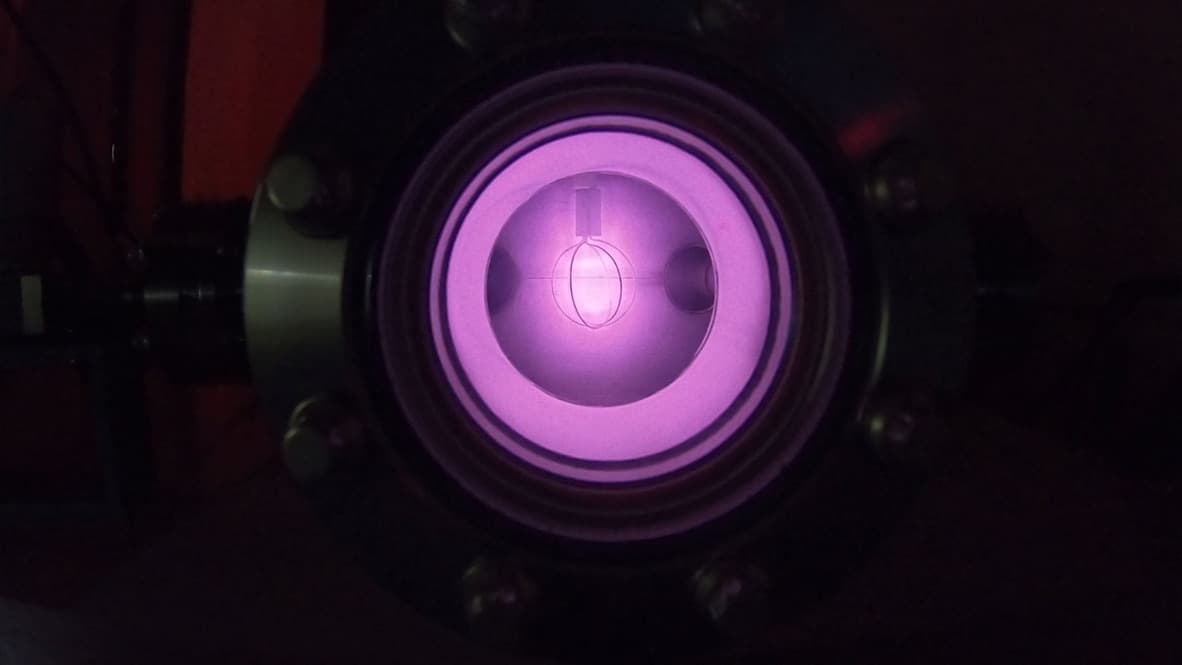
The visible magenta lobes are the optical signature of a stable IEC plasma: ions oscillating between the cathode meridians at energies of tens of keV. In Spring 2025 we matched every electrical, vacuum, and control parameter required for D-D fusion on a non-fusing surrogate gas. First fuel runs are scheduled for an off-campus partner facility in Fall 2026.
- Geometry
- Spherical
- Ion energy (peak)
- ~50 keV
- Visible signature
- D-α / D-β emission
- Status
- Plasma achieved · pre-fuel
Inertial electrostatic confinement · §04
No magnets.
Just voltage and geometry.
Fusion at lab scale usually means tokamaks, stellarators, or laser arrays — billion-dollar devices that confine plasma with superconducting magnets or pulse it with massive optics.
Inertial electrostatic confinement does it differently. A spherical cathode held at deep negative potential pulls deuterium ions toward the geometric center. Ions miss on the first pass, decelerate, recirculate, and accelerate inward again — gaining energy on every pass. At the center, they collide head-on at fusion-relevant energies.
Confinement is purely electrostatic. There's no plasma pressure to hold against magnetic field lines, no laser synchronization. Which is why the whole apparatus fits on a lab bench — and why it's the right architecture for a university research platform.
In Spring 2025, HELIOS Mk. 1 achieved plasma under full fusion operating conditions on a non-fusing surrogate gas — proof every subsystem works in concert. First D-D fusion runs are scheduled for an off-campus partner facility in Fall 2026.
Ultra-high vacuum · §05
From atmosphere to ten billionths.
Fusion only works in a very clean environment. HELIOS pulls the chamber more than ten billion times below atmospheric and operates at one ten-thousandth of atmospheric — every step computer- controlled with safety interlocks at every stage.
Fig. 05 · Pressure descent · log Torr
Two stages do the work. A mechanical roughing pump takes the chamber from atmosphere down to fore-vacuum — about four orders of magnitude — in minutes.
A turbomolecular pump with an integrated drag stage takes it the rest of the way, into ultra-high vacuum: 8 × 10⁻⁸ Torr, ten billion times below atmospheric. Once the gate valve in the foreline throttles open and the MFC starts dosing D₂, pressure climbs to a steady operating point near 10⁻³ Torr.
Throughout the sequence, every interlock is wired to the control system. Anything off-nominal closes the gate valve and deenergizes the supply.
Achieved · Spring 2025
- Ultimate pressure
- 8 × 10⁻⁸ Torr
- Operating pressure
- 1 × 10⁻³ Torr
- Gas purity during run
- 99.99%
High-voltage power · §06
Fifty thousand volts. Key-armed.
Accelerating deuterium ions to fusion-relevant energies means generating, monitoring, and controlling electrical potentials up to 50,000 volts — with stable beam currents and a safety stack that assumes the worst.
The supply lives in a fenced rack. Its output runs through a key-armed cable head and a ceramic CF feedthrough that drops a vertical conductor stalk into the chamber, terminating at the cathode grid.
Real-time telemetry — voltage, current, ramp rate — streams directly into the control system. The supply isn't a black box: every parameter is monitored, every interlock is wired. The team can drive it from the control PC, but only after a trained safety officer arms it with a physical key.
Maximum operating voltage
Stable beam current
Ion energy at peak — equivalent to hundreds of millions of K
Operator safeguards · all active
- Physical key — only safety officers can arm
- Audible alarm — broadcasts HV-armed and run states
- Warning light — visible HV-armed indicator at the rack
- Telemetry watchdog — anomalies cut HV in real time
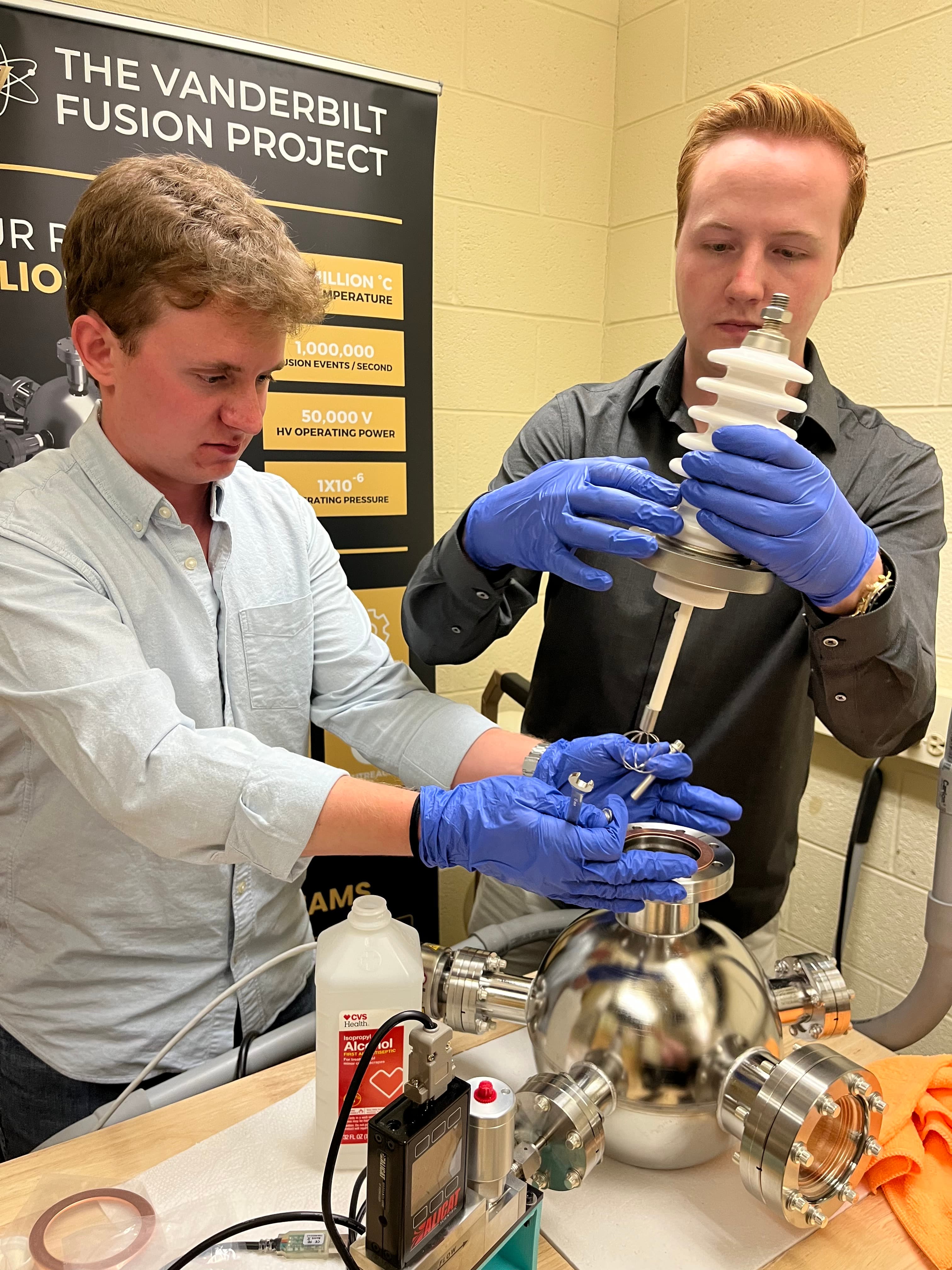
Plate · 2024
Installing the ceramic high-voltage feedthrough on HELIOS Mk. 1.
Machine learning controls · §07
The reactor learns to tune itself.
Where the Vanderbilt approach diverges from decades-old IEC designs. Live telemetry feeds plasma models and a machine-learning control layer — closed-loop, with humans in the audit seat instead of the driver's.
Fig. 07 · Closed-loop control
- 01
Sensors
V · I · P · neutron (planned)
Live electrical telemetry from the HV supply, vacuum gauges on the chamber and foreline, and — once D-D runs begin — neutron counts. Every sample is timestamped to a common run clock.
- 02
Plasma model
Physics + learned residuals
A first-principles plasma model interprets the telemetry stream — predicting where the plasma is, what it’s doing, and where the operating point is drifting. ML refines the model with run-by-run data.
- 03
Controller
PID + learned policy
Decides the next move: trim the gate-valve angle, adjust the MFC setpoint, ramp the HV. PID for the well-understood loops, a learned policy for the harder ones. Always under a hard envelope of safety constraints.
- 04
Reactor
HELIOS Mk. 1 hardware
Actuators move. Plasma responds. The new state shows up at the sensors on the next sample — and the loop closes.
Research applications · §08
A platform, not a stunt.
HELIOS is designed as a research instrument: low-cost access to an extreme plasma environment that has historically been gated behind national-lab budgets.
- [01]
Materials science
Neutron exposure & surface modification
Once D-D fusion runs begin, neutron output gives the team a controlled flux for materials studies — irradiation, defect formation, and surface modification under plasma. Useful work for fission and fusion materials labs alike.
- Neutron flux
- Surface mod
- Defect studies
- [02]
Nanotechnology
Particle-beam deposition & fabrication
Ion beams from the cathode region can deposit material with atomic-scale control. The team is exploring custom particle-beam recipes for nanomaterial fabrication and thin-film growth.
- Ion-beam deposition
- Thin films
- Custom recipes
- [03]
Plasma dynamics
Ground-truth data for models
Every run is logged. Live sensor data plus the eventual neutron telemetry give the modeling team ground-truth data to validate and refine plasma simulations — the kind of data large-facility teams pay millions for.
- Run archive
- Model validation
- Open data
- [04]
Next-gen fusion controls
ML approaches that transfer
The control architecture is designed to generalize: a small, well-instrumented platform is the right place to develop ML control techniques that could later transfer to larger fusion research devices.
- Closed-loop ML
- Transfer learning
- Anomaly flagging
Safety & compliance · §09
Engineered conservatively. Operated transparently.
Every off-nominal state cuts power before a human notices. Every operating boundary is documented. Every operator is signed off.
- 01
Vanderbilt EH&S approval
HELIOS Mk. 1 received Vanderbilt Environmental Health & Safety approval for operation under fusion operating conditions in Spring 2025. Every operating envelope is documented and reviewed.
- 02
Radiation profile
Under plasma operating conditions, no X-rays penetrate the chamber wall and there are no gamma emissions. A formal safety study and ALARA plan are in place for full fusion testing — covering neutron safety, X-ray mitigation, and dosimetry monitoring.
- 03
Training & access
Every team member completes Vanderbilt-mandated hazardous materials training before lab access. Operating roles require additional safety officer sign-off before independent runs.
- 04
Operator safeguards
The high-voltage supply is key-armed — only authorized safety officers can enable the stack. Audible alarms and warning lights signal HV-armed and run states, and a telemetry watchdog cuts HV automatically on any off-nominal reading.
Road to fusion · §10
Fall 2026.
First deuterium fusion.
With plasma achieved and EH&S approval secured, the next milestone is fusion itself. We're partnering with an off-campus facility equipped for D-D fuel handling to conduct our first fueled runs.
- Q3 2025ACTIVE
Operational data collection
Continued runs on HELIOS Mk. 1 to characterize stable operating envelopes ahead of fueled runs.
- Q1 2026PLANNED
Off-campus partnership build-out
Hardware integration with the partner facility’s D-D fuel handling and shielding infrastructure.
- Q3 2026PLANNED
First D-D fusion runs
First fueled runs at the partner facility — neutron telemetry confirms first fusion events.
- Q4 2026 +ROADMAP
Mk. 2 design
Operational learnings from Mk. 1 feed Mk. 2 — second-generation chamber, supply, and control stack.