

Mason Anton
Chief Executive Officer
Directs executive operations, system teams, and cross-functional programs.
Team · 60+ People · 24+ Majors
The Vanderbilt Fusion Project is built by undergraduates from across the university — engineering, physics, computer science, biomed, biochem, political science, history. The interdisciplinary mix is the point.
60+
Team Members
24+
Majors
8
Founders
4
System teams
Mission
Hands-on research should be accessible — not gated behind billion-dollar labs. That belief started the Vanderbilt Fusion Project, and it still drives every decision the team makes.
The reactor is the destination. The team is the point. Every member graduates with skills you can't get in a classroom: ultra-high vacuum engineering, high-voltage systems, plasma modeling, real-world safety compliance, and the hard-won experience of shipping a research platform built from scratch.
In 2022, a group of Vanderbilt freshmen were brainstorming what they could build together — the kind of ambitious, not-quite-realistic ideas that get tossed around in a dorm lounge at 2 a.m. One idea stood out.
“What if we built a nuclear fusion reactor?”
In typical Vanderbilt fashion, the group said yes. Within a year, the project had grown to forty undergraduates from twenty-two majors across three schools. By 2024, HELIOS Mk. 1 was fully assembled — tucked into a Stevenson Center lab, wired, pumped down, and ready. In Spring 2025, it achieved plasma under fusion operating conditions and received Vanderbilt EH&S approval.
The founding team believed something that sounded naïve at the time and looks prescient now: that a group of undergraduates, given the right mentorship and enough stubbornness, could build research hardware most universities don't even attempt.
They were right. The reactor is lit.
Milestone by milestone, mentor by mentor — here is where the project has been, and where it stands today.
The Vanderbilt Fusion Project starts as a late-night idea in a freshman residence hall. Eight founders, no lab, no hardware — just a thesis: undergraduates can build a real reactor.
The Office of the Chancellor and Vanderbilt University commit institutional support through the V150 Dare to Grow campaign — pairing it with founding benefactors Suzanne & Michael Ainslie, Stephanie & John Ingram, and Hatch Investments LLC. Special thanks to Teddy Raskin, Vanderbilt alumnus and early advisor, whose invaluable support helped move the project from idea to institutional reality.
The roster doubles, then doubles again. Vanderbilt News publishes the first feature on the project, leadership is invited to the Clinton Global Initiative roundtable, and HELIOS Mk. 1 is presented at Oak Ridge National Laboratory.
The reactor is welded, wired, and pumped down inside its Stevenson Center home. The team kicks off UT Austin Energy Week as guests of the PUCT Commissioner and the American Nuclear Society — and turns its attention to the safety case for fusion operating conditions.
Vanderbilt EH&S certifies HELIOS Mk. 1 for full fusion operating conditions. On April 24, the reactor produces first plasma — at the project's largest-ever team of sixty students.
HELIOS is a working research instrument. The team is running plasma campaigns to characterize IEC behavior, developing a machine-learning closed-loop controller in R&D, and pushing the platform into advanced physics adjacencies — particle accelerator work, materials science, extreme-environment instrumentation. First fusion is locked in for Fall 2026.
The state of the initiative · 2026
With HELIOS Mk. 1 commissioned, the work has shifted from building the reactor to using it. The platform is now a research instrument, and the team's focus has fanned out across three concurrent frontiers.
Plasma exploration
Sustained plasma campaigns to characterize IEC behavior at the HELIOS envelope — convergence morphology, stability, diagnostic instrumentation, and the experimental playbook that will run on every future shot.
ML control loop · in R&D
The Computational Physics team is developing a machine-learning closed-loop controller that will eventually tune the reactor in real time against plasma response. Not yet operational — actively in research and prototyping against the data we are now collecting.
Advanced physics systems
Advanced Concepts is pushing the platform into adjacent research territory — particle accelerator work, materials science under extreme conditions, and the kind of physics problems an IEC reactor on campus uniquely makes possible.
Underneath all of it: first fusion, in Fall 2026, at a partner facility equipped for the deuterium campaign.
Beyond the lab · Where members go
A non-exhaustive sample of the companies, labs, and programs where current members and alumni work, intern, and conduct research.









The Founding Eight · 2022
Eight first-years started this project in a Vanderbilt dorm room in 2022. All eight graduated in 2025 — sixty students later.
Tommy Pennington
Co-Founder · Founding CEO · President
2022–2025
 [02]Founder
Alli Hoying
Co-Founder · Co-Chief Safety Officer
2022–2025
Zachary Klinger
Co-Founder
2022–2025
Anders Westermann
Co-Founder
2022–2025
Emma Bufkin
Co-Founder · Co-Chief Safety Officer
2022–2025
Logan Glazier
Co-Founder · Chief Operating Officer
2022–2025
Jackson Singer
VP of Engineering
2022–2025
Jackson Cornett
VP of Engineering
2022–2025
Three leaders · One mission
2022–2023
Tommy Pennington
Founding CEO · #01
2023–2024
Catherine Knox
CEO · #02
2025–2026
Mason Anton
CEO · #03
Currently leading · 2025–2026
The executives running day-to-day operations across reactor systems, safety, business, and technology.
Chief Executive Officer
Directs executive operations, system teams, and cross-functional programs.
Chief Operating Officer
Runs business operations, coordinates with the University, and leads fundraising and partnerships.
Chief Safety Officer
Directs the safety program across vacuum, gas, electrical, and radiation; ensures compliance with University, State, and Federal regulations.
Chief Technology Officer
Oversees technical operations across reactor systems, electronics, and control projects.
System teams · Four fronts
Each system team owns a slice of HELIOS Mk. 1 — and reports back into a single executive structure.
Vacuum, flowing gas, and chamber engineering — the physical body of HELIOS.
High-voltage power, sensor instrumentation, and the mechatronics that make the reactor armable and safe.
Plasma modeling and applied machine learning — the closed-loop control layer that learns to tune the reactor.
Particle accelerators, materials science, and the research adjacencies an extreme plasma platform unlocks.
Recognition · Outside the lab
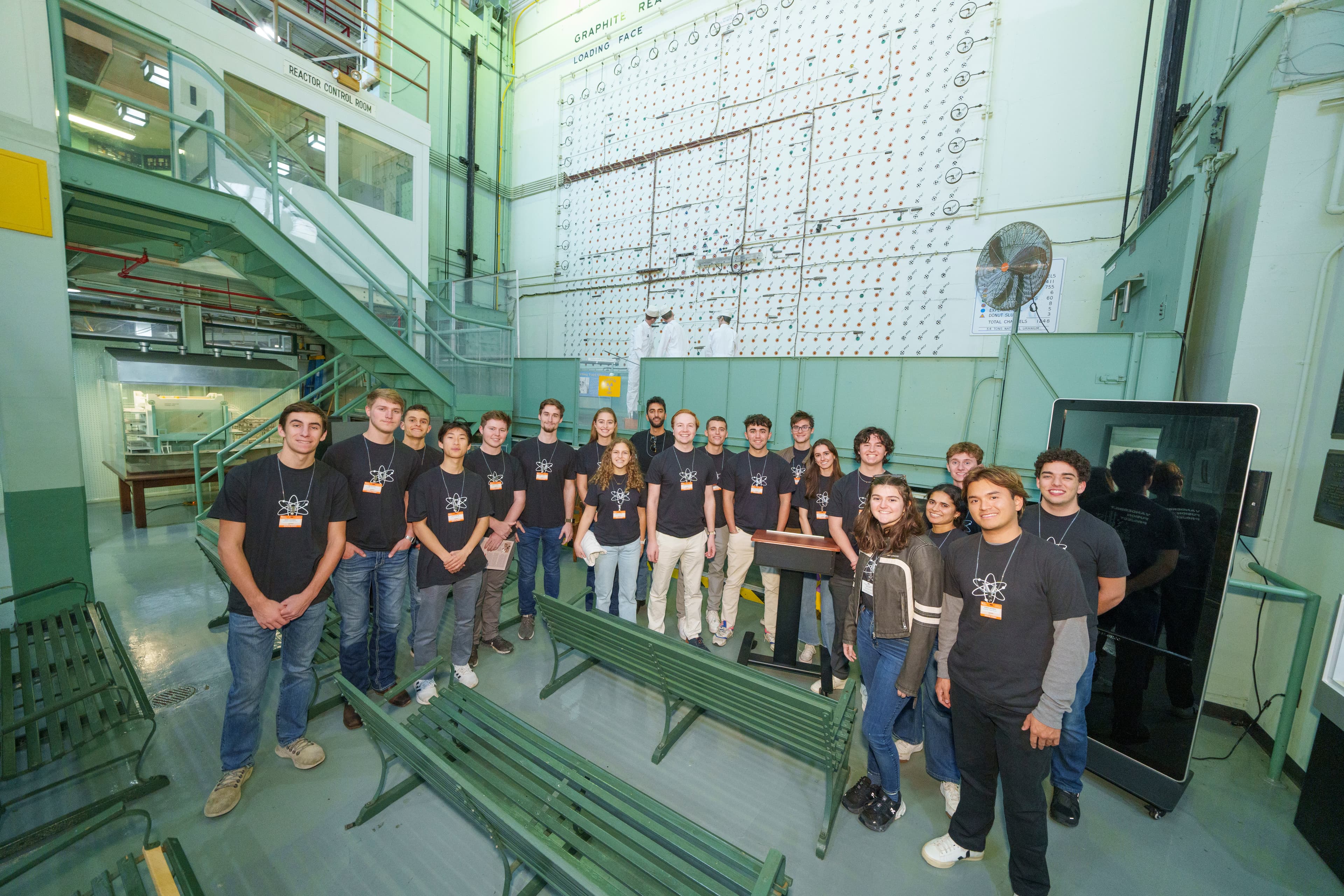
Moments outside the Vanderbilt lab — representing Vanderbilt at the Clinton Global Initiative, joining a private nuclear roundtable at UT Austin Energy Week, and presenting HELIOS Mk. 1 to leadership at Oak Ridge National Laboratory.
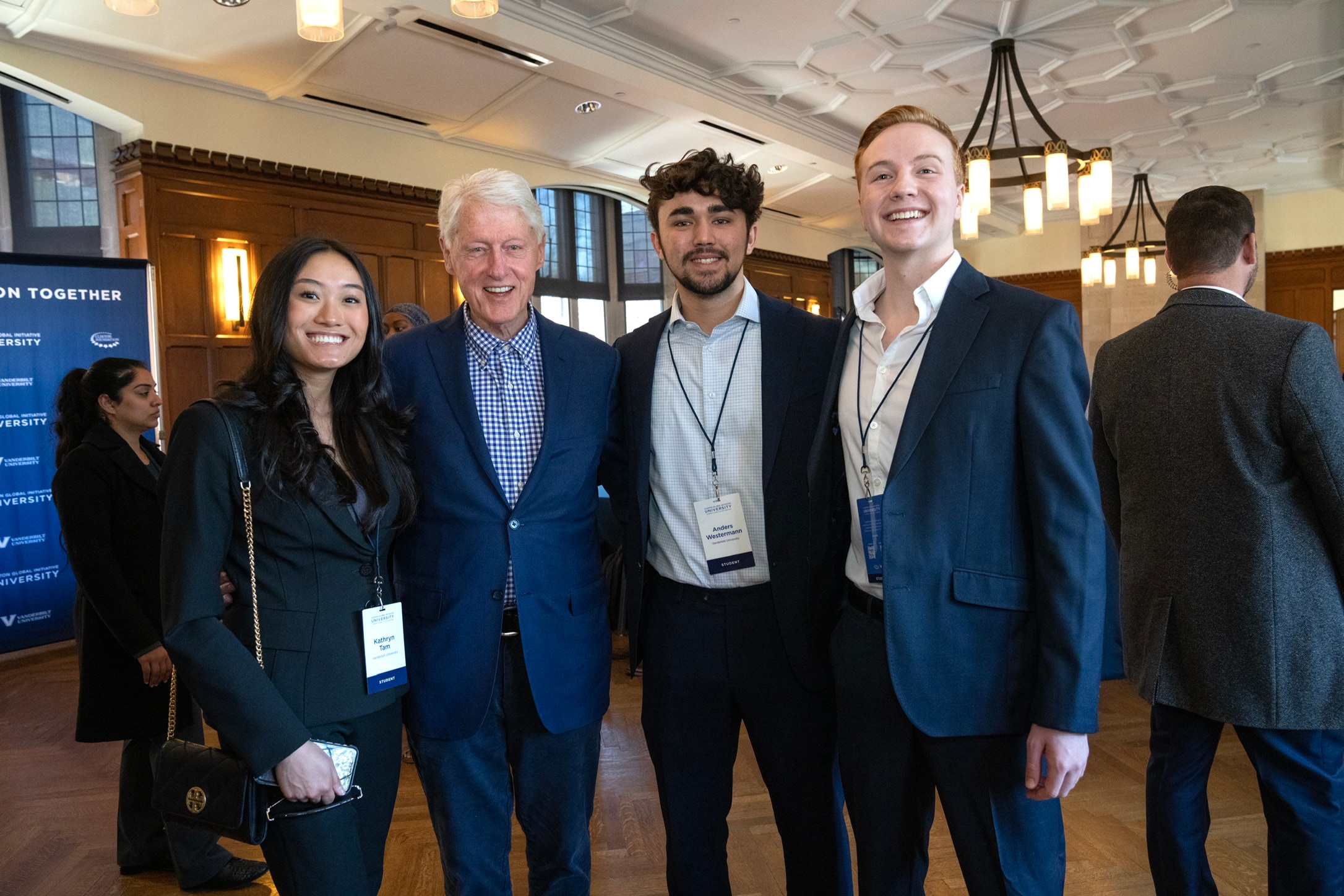
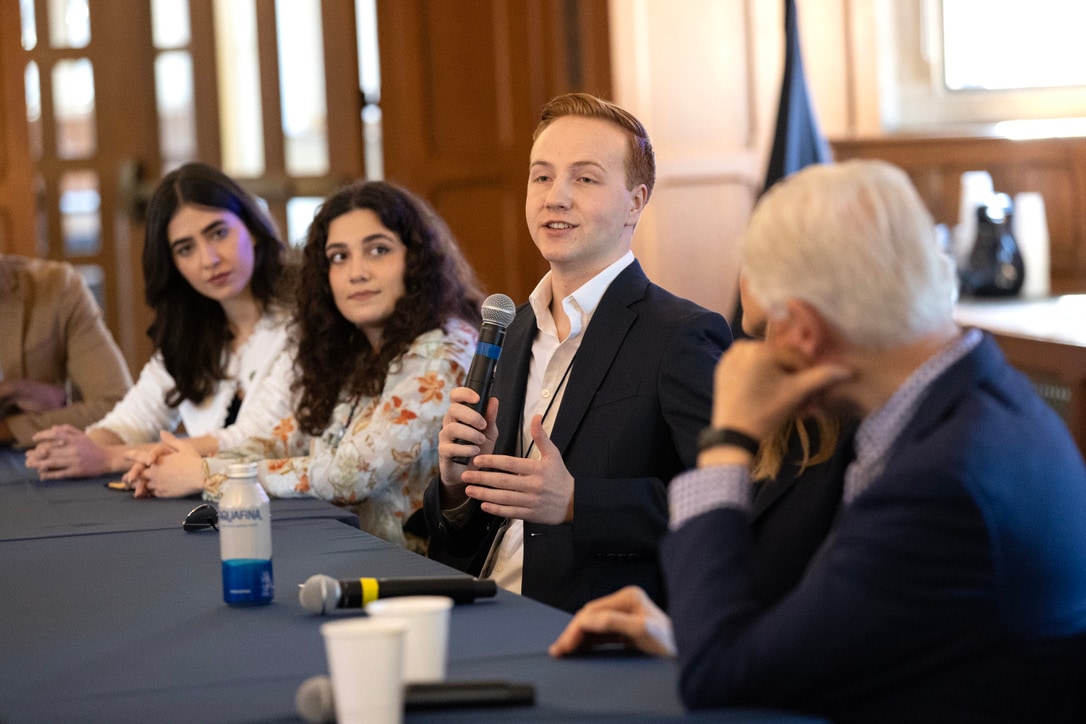
Roundtable · CGI 2023
Invited to represent Vanderbilt at a private roundtable with President Bill Clinton — on fusion's role in sustainability, economic growth, and the next generation of innovators.
Representing Vanderbilt
President Bill Clinton
42nd President of the United States · Founder, Clinton Global Initiative
Tommy Pennington
CEO · Delivered remarks on fusion energy, sustainability & next-gen innovation
Anders Westermann
CFO · Vanderbilt Fusion Project
Kat Tam
CSO · Vanderbilt Fusion Project
The current roster · 47 active
Filter by track, or scroll the whole roster. Hover a portrait for the LinkedIn shortcut.
Trent Bednar
Physics & Applied Mathematics
Sean Confoy
Mechanical Engineering
Ron Asoulin-Handelman
Computer Science
Natalie Carrión
Electrical & Computer Engineering and Computer Science
Megan Landis
Mechanical Engineering
John Hague
History & English
Colin Strout
Electrical and Computer Engineering
Isabella Nelson
Computer Science
Isabel Madrid
Civil Engineering
Farouk Ramzan
Psychology & Economics
Ashank Awasthy
Computer Science
Carson Felton
Chemical Engineering and Data Science
Bryce Ware
Electrical & Computer Engineering
Abbott Heerden
Physics and Mathematics
Sammy Kassan
Biomedical Engineering
Ella Provancher
Biomedical Engineering
Michael Taleb
Computer Science and Mathematics
Bucky Aboud-Hall
Biomedical Engineering and Electrical & Computer Engineering
Camile Gowda
Electrical & Computer Engineering
Catherine Knox
Mechanical Engineering
Jonathan Wilson
Mechanical Engineering
Penelope Fries
Engineering Science
Blake Layman
Human & Organizational Development and Computer Science
Brooke Byrne
Biomedical Engineering
Tuna Zevkirlioglu
Physics and Economics
Eli Pruzan
Chemical Engineering
Henry Coleman
Engineering Science
Julia DeMeritt
Biomedical Engineering
Katelyn Moore
Biochemistry & Art History
Nicholas de la Guardia
Economics and Human & Organizational Development
Reese Flechner
Biomedical Engineering
Seth Hemingway
Biomedical Engineering
Nirmal Alla
Computer Science and Mathematics
Solomon Tolson
Electrical and Computer Engineering
Samuel Wang
Electrical & Computer Engineering
Pranav Narayanan
Biomedical Engineering
Kunal Bham
Computer Science and Political Science
Thomas Hogarty
Mathematics and Economics
Avyay Parmeswaran
Economics and History
Lucas Barash
Economics and Political Science
Jan Jedynak
Biochemistry and Law, History & Society
Sonam Thukral
Electrical & Computer Engineering
Aaron Gleitman
Mechanical Engineering
Pruett Fredorowicz
Manish Kota
Neuroscience and Biomedical Engineering
Zachary Hunter
Mechanical Engineering
Errita Xu
Computer Science
Hall of Fame · Alumni record
Founders and leaders who shipped HELIOS Mk. 1 from sketch to first plasma.
Principal Investigator · Faculty Advisor
Professor Will Johns is a high-energy physicist and long-time CERN researcher. His work has spanned some of the largest experimental collaborations in modern physics — and his mentorship grounds the Vanderbilt Fusion Project in the research tradition it aspires to contribute to. As Principal Investigator, Prof. Johns oversees the scientific direction of HELIOS Mk. 1, supports the student-led research agenda, and connects the team to the broader high-energy and plasma physics community.
Staff Engineer · School of Engineering
Rich has been part of the project since the early days, when the founders first crossed paths with him in his civil and environmental engineering structures lab. His hands-on engineering mentorship has been central to the team's ability to move from design to fabrication.
Recruit · Open every semester
We recruit across every major at Vanderbilt. Curiosity and commitment matter more than prior experience.


